Jump to Blog Sidebar & Archives
Archives May 2018

By Eric Chabot, CJF Midwest Represenative (note: feel free to email me questions at ericc@cjfm.org).
Over the years, I have had the privilege of teaching on Jewish backgrounds of the Christian faith. Just a quick clarification: Understanding the Jewish backgrounds of the Christian faith is not the same as being part of the Hebrew Roots movement.
But I think it is significant that when Marvin Wilson released his book last year called Exploring Our Hebraic Heritage: A Christian Theology of Roots and Renewal, David Neff, who is former editor of Christianity Today, said the following:
“As a historical religion, Christianity must own its Jewish origins and live up to the best of that heritage. Marvin Wilson, a pioneer in evangelical-Jewish relations, makes a compelling argument for renewing Christian faith by recovering our Hebraic heritage. If only there were more like him, we could have a healthier church.”
So what about the renewal aspect that Neff mentions here? Here are five lessons Christians can learn from the Jewish roots of their faith.
#1: Yeshua and the Name of God
Regarding the disciples prayer (Matthew 6: 9-13), Yeshua says:
This, then, is how you should pray: “‘Our Father in heaven, hallowed be your name, your kingdom come.”
Regarding the hallowing of God’s name, Scot McKnight says:
“At no place have Christians been more insensitive to Judaism that when it comes to what Jesus believes and teaches about God. In particular, the concept that Jesus was the first to teach about God as Abba and that this innovation revealed that Jesus thought of God in terms of love while Jews thought of God in terms of holiness, wrath, and distance are intolerably inaccurate in the realm of historical study and, to be quite frank, simple pieces of bad polemics. The God of Jesus was the God of Israel, and there is nothing in Jesus’ vision of God that is not formed in the Bible he inherited from his ancestors and learned from his father and mother” “Countless Christians repeat the Lord’s Prayer. When Jesus urged His followers to “hallow” or “sanctify” the Name of God (Matt 6:9), many are unaware of what that may have meant in Jesus’ day- in part, because Christianity has lost sight of God’s awesome splendorous holiness. A good reading of Amos 2:6-8 discusses this issue. “Reverencing the Name of God” is not just how Israel speaks of God-that it does not take the Name of God in vain when it utters oaths or when someone stubs a toe or hits a finger with an instrument -but that God’s Name is profaned when Israel lives outside the covenant and by defiling the name of God in it’s behavior” (Jer 34:15-46; Ezek. 20:39; Mal 1:6-14).
God’s Name is attached to the covenant people, and when the covenant people lives in sin, God’s Name is dragged into that sin along with His people. So, when Jesus urges his followers to “reverence,” or “sanctify” the Name of God, he is thinking of how his disciples are to live in the context of the covenant: they are to live obediently as Israelites.” -Paul Copan and Craig A. Evans. Who Was Jesus? A Jewish-Christian Dialogue. Lousiville: KY.Westminster John Knox Press. 2001, 84-85.
#2: Discipleship
The Hebrew word for disciple is “talmid.” A talmid is a student of one of the sages of Israel. A disciple is a learner, or pupil. When we decide to repent and turn to our Lord for the forgiveness of sins, we have to realize we are now on a new journey. The Gospel is a message for the here and now- not just the future. We have to learn how to live out our faith in the world around us. A disciple (in the New Testament sense) is someone who is striving (by God’s grace) to be consistent follower of Yeshua.
The goal of the Christian is to imitate our Master.
Discipleship takes a commitment between the discipler and the one being discipled. For those that say they don’t need discipleship, you are setting yourself up for failure. Sorry to be so blunt. But there is no such thing as a Long Ranger Christian.
Discipleship is not getting any easier in the world we live in. In an overly sensate culture, people need to be constantly stimulated and have a hard time focusing on something such as discipleship. In a world that wants instant results, self- sacrifice is tough sell. Part of the problem is that churches preach a Gospel that promises that Jesus will fix all our problems. And when things get tough, many people bail out. A long-term commitment to our Lord which involves self denial (Luke 9:23) is hard to swallow for those that have been told The American Dream is the way of happiness.
#3: The Shema
In Mark 12.28-34 we find a scribe asking Jesus a serious question, “What commandment is the foremost of all?” Jesus replied by quoting the Shema, “Hear, O Israel! The Lord our God is one Lord; and you shall love the Lord your God with all your heart, and with all your soul, and with all your mind, and with all your strength.” Jesus then added to the Shema a second commandment (from Leviticus 19.18) when he said, “The second is this, You shall love your neighbor as yourself.”
The Shema is seen in the following text:
“Hear, O Israel: The Lord our God, the Lord is one. You shall love the Lord your God with all your heart and with all your soul and with all your might. And these words that I command you today shall be on your heart.You shall teach them diligently to your children, and shall talk of them when you sit in your house, and when you walk by the way, and when you lie down, and when you rise. You shall bind them as a sign on your hand, and they shall be as frontlets between your eyes.You shall write them on the doorposts of your house and on your gates.-Deut 6:4-9
This was something every Jewish child would memorize at a very early age. As we see here, in Deut : 6: 4-9, we see who our God is and how we should respond to him. It should be a holistic commitment towards him. We are to love him with everything. Not just our
heart and strength but with our very lives! We love our God with our emotions, our actions, and our entire beings (including our minds).
#4: What Does it Mean to say Jesus is the “Christ”?
There is no doubt that the major identity marker for a committed Christian is to say they follow Jesus Christ. But for the average Jewish person, the name “Jesus Christ” has no relationship to Judaism. And for the average Christian, there is little a very limited understanding as to what it means to even say Jesus is “The Christ.” In my personal experience, many of my Christian friends are fully convinced that Jesus is the Savior of the world. Millions of sermons as well as evangelistic appeals are given each year to people to accept Jesus as their personal Savior. But when it comes to thinking about whether Jesus is actually the promised Messiah of Israel and the nations, many Christians know every little about what it means to affirm Jesus is actually the Messiah. Michael Bird says it so well:
The statement that “Jesus is the Messiah” presupposes a certain way of reading Israel’s Scriptures and assumes a certain hermeneutical approach that finds in Jesus the unifying thread and the supreme goal of Israel’s sacred literature. A messiah can only be a messiah from Israel and for Israel. The story of the Messiah can only be understood as part of the story of Israel. Paul arguably says as much to a largely Gentile audience in Rome: “For I tell you that Christ [Messiah] has become a servant of the circumcised on behalf of the truth of God in order that he might confirm the promises given to the patriarchs, and in order that the Gentiles might glorify God for his mercy” (Rom. 15:8–9), Michael Bird , Michael F. Bird, Are You the One Who Is to Come? The Historical Jesus and the Messianic Question (Grand Rapids, Baker, 2009), 163.
But if we probe deeper, the Greek word Christos, from which we get the English word “Christ” carries the same connotations as the Hebrew word — “the Anointed One” which is where the word “messiah” comes from. The word “messiah” means “anointed one” and is derived from verbs that have the general meaning of “to rub something” or, more specifically, “to anoint someone.” The Jewish Scriptures records the history of those who were anointed for a specific purpose such as priests (Exod. 28:41; 29:7, 29; 30:30; Lev. 7:36; 8:12; 16:32;), kings (Jdg. 9:8; 9:15; 1 Sam. 9:16; 10:1; 15:1, 17; 16:3, 12, 13; 2 Sam. 2:4, 7; 3:39; 5:3; 1 Chron. 11:3; 5:17; 127; 2 Sam. 19:11; 1 Kgs. 1:34, 39, 45; 5:15;19:15,16; 2 Kgs 9:3, 6,12;11:12; 23:30; 2 Chron. 22:7; 23:11; 29:22; Ps 89:21), and even prophets (1Kgs.19:16; 1 Chron.16:22; Ps.105:15)
After teaching on this topic for several years, Dr. Brant Pitre summarizes the challenge that lays before us:
“Regarding Jesus, according to the testimony of the four Gospels, who did he claim to be? Who did his first followers believe him to be? And, even more important, why did they believe in him? As soon as we ask this question, we run into a bit of a problem—a paradox of sorts. I’ve noticed this paradox over the last ten years that I’ve been teaching the Bible as a professor in the classroom. On the one hand, if I ask my students what kind of Messiah the Jewish people were waiting for in the first century AD, they all seem to be very clear about the answer. Usually, their standard response goes “At the time of Jesus, the Jewish people were waiting for an earthly, political Messiah to come and set them free from the Roman Empire.” On the other hand, if I ask students which prophecies led to this ancient Jewish hope for an earthly, political Messiah, they are often at a complete loss. The classroom quickly falls silent. They often get even quieter when I ask, “Which prophecies of the Messiah did Jesus actually fulfill?” or “What prophecies did the first Jewish Christians think he fulfilled?” Every time I pose these questions, the vast majority of the students (who are usually all Christians) can’t answer them. They often can’t name a single prophecy that Jesus fulfilled that would show that he was in fact the Messiah. Every now and then, one or two students may bring up the oracle of the virgin who bears a child (Isaiah 7) or the passage about the Suffering Servant (Isaiah 52–53). However, that’s usually as far as it goes. If my experiences are any indication, many contemporary Christians believe that Jesus was the Messiah, but they don’t necessarily know why they believe he was the Messiah, much less why his first followers thought he was the long-awaited king of Israel.”—B. Pitre, The Case for Jesus: The Biblical and Historical Evidence for Christ(New York: Crown Publishing. 2016), 102-103.
I hope these four lessons can enhance your faith and help you to be a stronger disciple of Yeshua the Messiah.
By Eric Chabot, CJFM Midwest Representative
Over the years, I have seen a lot of confusion about the relationship between the Old and New Testament. Christians tend to be very confused about how to bridge the gap between the Testaments. Granted, some Christians just ignore the entire Tanakh (i.e.,Old Testament). Yes, this happens! Why is their so much confusion?
First, we can tend to forget there was no New Testament at the time of Jesus. Paul stated: “All scripture is given by the inspiration of God and is profitable for doctrine, for reproof, for correction, for instruction in righteousness: that the man of God may be perfect, thoroughly furnished unto all good works” (2 Timothy 3:16-17). Here “Scripture” (graphē) must refer to the Old Testament written Scripture, for that is what the word graphē refers to in every one of its fifty-one occurrences in the New Testament.
Second, many Christians assume the way it is today was the way it was in the first century.
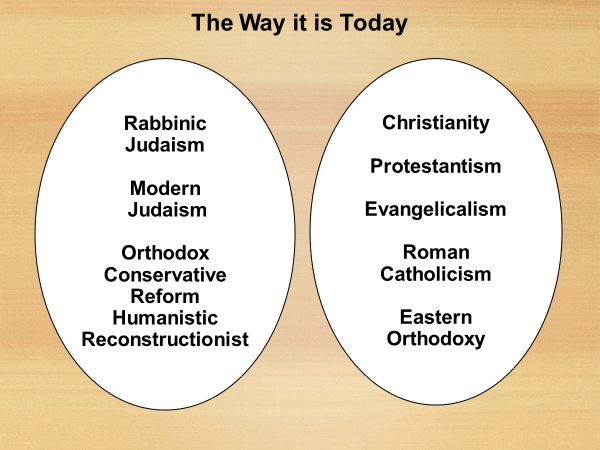
As I have said before, this is the problem of paradigms. As Ronald Timothy says:
" Paradigms can be so strong they act as psychological filters – we quite literally see the world through our paradigms. Any data that exists in the real world (or even in the Bible) that does not fit our paradigm will have a difficult time getting through our filters. We are quite literally unable to perceive the facts right before our eyes. Thus, our greatest strengths can become our greatest weakness by not allowing us to see both the need and the opportunity for change. The people who create new paradigms are usually outsiders. They are not part of the established paradigm community. “– Ronald Timothy, Following Jesus: Our Cruciform Example
Because of the first diagram is sometimes assumed by many Christians, it leads to the problem that is stated by Walter Kaiser:
“God never intended that the two testaments should result in two separate religions: Judaism and Christianity. The Tanach (= OT) was meant to lead directly into the so-called New Testament and thus be the continuation of one plan from creation to consummation. When the divine promise-plan of God is ruptured and divided into two distinct parts, with the climax triumphing over the earlier revelation, then we have introduced a division where God had revealed the fulfillment of what he had revealed in earlier texts! Therefore, we must investigate further how this disparity appeared among the people of God”- Walter Kaiser, Jewish Christianity: Why Believing Jews and Gentiles Parted Ways in the Early Church
In reality, the way it was in the first century was this diagram:
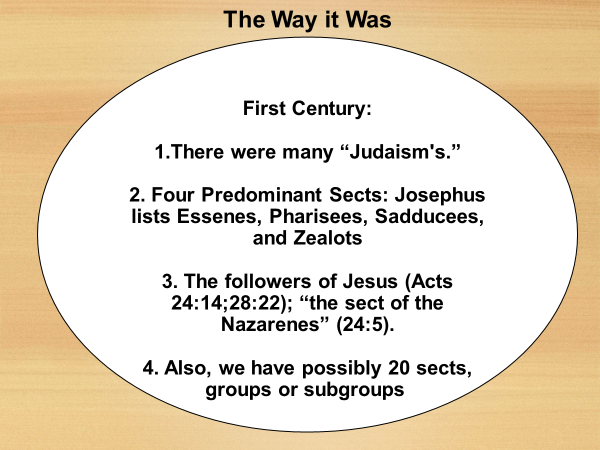
Linguistically speaking, Christianity didn’t exist in the first century. Judaism in the first century wasn’t seen as a single “way.” There were many “Judaisms”- the Sadducees, the Pharisees, Essenes, Zealots, etc. The followers of Jesus are referred to as a “sect” (Acts 24:14; 28:22); “the sect of the Nazarenes” (24:5). Josephus refers to the “sects” of Essenes, Pharisees, Sadducees. The first followers of Jesus were a sect of Second Temple Judaism. Even James Dunn says the following:
“Prior to Paul what we now call ‘Christianity’ was no more than a messianic sect within first-century Judaism, or better, within Second Temple Judaism — ‘the sect of the Nazarenes’ (Acts 24.5), the followers of ‘the Way’ (that is, presumably, the way shown by Jesus)”- James Dunn, Jesus, Paul and the Gospels, pg 119.
The New Covenant
Third, in most cases, many Christians assume the New Testament=new covenant. The New Testament contains 27 texts, and all of them were written sometime during the first-century CE. Is there something "new" about the message that Jesus brought? Yes, and no. We can't just jump to Mark 14:24-25 or Heb. 8:8–12 and assume that is all we need to know about the new covenant. The first place to start is in the Scriptures that Jesus, Paul, and the apostles were raised on.
The only place the words “new covenant” are seen is the following text:
Behold, days are coming,” declares the Lord, “when I will make a new covenant with the house of Israel and with the house of Judah, not like the covenant which I made with their fathers in the day I took them by the hand to bring them out of the land of Egypt, My covenant which they broke, although I was a husband to them,” declares the Lord. “But this is the covenant which I will make with the house of Israel after those days,” declares the Lord, “I will put My law within them and on their heart I will write it; and I will be their God, and they shall be My people. They will not teach again, each man his neighbor and each man his brother, saying, ‘Know the Lord,’ for they will all know Me, from the least of them to the greatest of them,” declares the Lord, “for I will forgive their iniquity, and their sin I will remember no more (Jer. 31: 31-34).
Though Ezekiel never uses the phrase “new covenant,” he does mention a similar theme as Jeremiah:
Therefore say, ‘Thus says the Lord God, “I will gather you from the peoples and assemble you out of the countries among which you have been scattered, and I will give you the land of Israel.”’ When they come there, they will remove all its detestable things and all its abominations from it. And I will give them one heart, and put a new spirit within them. And I will take the heart of stone out of their flesh and give them a heart of flesh, that they may walk in My statutes and keep My ordinances and do them. Then they will be My people, and I shall be their God (Ezek. 11: 17-20).
I will vindicate the holiness of My great name which has been profaned among the nations, which you have profaned in their midst. Then the nations will know that I am the Lord,” declares the Lord God, “when I prove Myself holy among you in their sight. For I will take you from the nations, gather you from all the lands and bring you into your own land. 25 Then I will sprinkle clean water on you, and you will be clean; I will cleanse you from all your filthiness and from all your idols. Moreover, I will give you a new heart and put a new spirit within you; and I will remove the heart of stone from your flesh and give you a heart of flesh. I will put My Spirit within you and cause you to walk in My statutes, and you will be careful to observe My ordinances. You will live in the land that I gave to your forefathers; so you will be My people, and I will be your God (Ezek. 36: 23-28).
Just like the giving of the Torah (with Moses), the new covenant needs someone to inaugurate it. We just read about the day when God will place his Spirit permanently inside people so they can walk in holiness and love. We can summarize some of the benefits of the new covenant here:
- God promises the forgiveness of sin.
- God pledged the indwelling Ruach Ha Kodesh (The Holy Spirit)
- God promises the knowledge of God.
- God promises His people would obey Him.
- The fulfilling of this covenant was tied to Israel’s future restoration to the land.
Gentiles Participation in the New Covenant
Now that we see the passages in the Jewish Scriptures about the promise of the coming of the New Covenant, how can Christians and Messianic believers claim this new covenant was inaugurated if universal forgiveness for sins has not come to Israel? It is abundantly clear that the Lord made the new covenant with the house of Israel and the house of Judah (see Jer. 31:31–34, quoted in Heb. 8:8–12) and not with the nations of the world, which leads us to ask the question: How do Gentiles get to partake in the new covenant? In response, God’s plan for Israel was to be a light to the nations and be a conduit for Gentiles to come to faith in the one true God. The only way Gentiles get to partake in the new covenant is that they are grafted in as Paul talks about in Rom. 11: 13-24. But what's the point? There would be no understanding of the new covenant apart from the Jewish Scriptures.
Did Jesus Come to Bring a New Religion?
Another reason Christians have a problem with bridging the Testaments is because many Christians still assume the Old Testament is synonymous with law (Judaism) and the New Testament is synonymous with grace (Christianity). This plays out when some assume Jesus came and brought a brand new religion. But as Craig Evans says:
“Did Jesus intend to found the Christian church? This interesting question can be answered in the affirmative and in the negative. It depends on what precisely is being asked. If by church one means an organization and a people that stand outside of Israel, the answer is no. If by a community of disciples committed to the restoration of Israel and the conversion and instruction of the Gentiles, then the answer is yes. Jesus did not wish to lead his disciples out of Israel, but to train followers who will lead Israel, who will bring renewal to Israel , and who will instruct Gentiles in the way of the Lord. Jesus longed for the fulfillment of the promises and the prophecies, a fulfillment that would bless Israel and the nations alike. The estrangement of the church from Israel was not the result of Jesus’ teaching or Paul’s teaching. Rather, the parting of the ways, as it has been called in recent years, was the result of a long process”—Craig Evans , From Jesus to the Church: The First Christian Generation.
Evans goes onto say:
But we must ask if Paul has created a new institution, a new organization, something that stands over against Israel, something that Jesus himself never anticipated. From time to time learned tomes and popular books have asserted that the Christian church is largely Paul’s creation, that Jesus himself never intended for such a thing to emerge. Frankly, I think the hypothesis of Paul as creator of the church or inventor of Christianity is too simplistic. A solution that is fairer to the sources, both Christian and Jewish, is more complicated. -Evans, Craig A., From Jesus to the Church: The First Christian Generation.
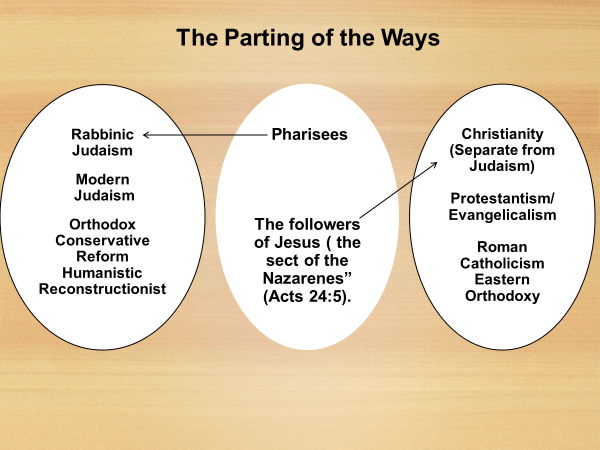
Look at both quotes from Evans in this post. From my own experience, most Christians like the current boundaries. In other words, we have two separate religions, Judaism and Christianity. Thus, we don’t care much about how we got to that place. One thing for sure: If we discuss the “imperial Christianity” that was legalized in the fourth century by Constantine and whether Jesus or Paul is the founder of that, the answer is no. By then, the Christianity that existed was so far away from what Jesus and Paul had done, it had morphed into a new and separate religion. Here are a couple of pictures to help summarize where we are today:
Just recently, I was having a discussion with a friend of mine about how Christians approach the Old Testament. He happened to pass this quote on to me by Richard B. Hays who says the following:
“Many “mainstream” Protestant churches today are in fact naively Marcionite in their theology and practice: in their worship services they have no OT reading, or if the OT is read it is rarely preached upon. Judaism is regarded as a legalistic foil from which [Yeshua] has delivered us. (I once had a student say to me in class: “Judaism was a harsh religion that taught people to fear God’s judgment, but Jesus came to teach us to love God with all of our heart and soul and strength.”) This unconscious Marcionite bias has had a disastrous effect on the theological imagination of many Protestant churches, at least in the United States….” – Richard B. Hays, Reading Backwards: Figural Christology and the Fourfold Gospel Witness (Waco: Baylor University, 2014), 5.
For the record, Marcion believed Jesus was the Son of God, but he rejected the Old Testament and the God of Israel. He also believed the God of the Old Testament was a wrathful God while the God of the New Testament was a God of love and forgiveness. To see more about Marcion, see here:
So, is Hays correct? I think he is. How do we correct this? Well, the good news is that Kaiser, who is an Old Testament scholar gives us some helpful tips. As Kaiser says:
” The Old Testament was the Bible of the early church. Yet one more objection can be heard from some detractors. “Now that we have the New Testament, should we not go to the New Testament first to form an understanding of the Bible’s teachings and then go backward into the Old Testament, interpreting it in the light of the New Testament?” This approach is advocated so frequently in the church today that it must be faced squarely. This whole approach is wrongheaded historically, logically, and biblically. As we have seen, the first New Testament believers tested what they had heard from Jesus and his disciples against what was written in the Old Testament. They had no other canon or source of help. How, then, were they able to get it right? Thus, from a methodological point of view, reading the Bible backward is incorrect historically as well as procedurally. What is more, the early church knew the Old Testament to be true; therefore, logically, they could not have tested what was established (and true) for them (possessing only the Old Testament) by what was being received as new (the New Testament)! That would be a reversal of the natural, historical, and logical order of things.”
To read the entire article, see here.
In conclusion, I hope Christians will see the Bible is one continuous story and not divorce the Testaments.

By Eric Chabot, CJF Midwest Representative
The reign of God is one of the most pertinent themes in biblical theology.The term “kingdom of God” is absent from the Tanakh. However, the God of Israel is identified as King: (1 Samuel 12:12; Psalm 24:10; Isa 33:22; Zeph 3:15; Zech 14:16-17), as ruler over Israel (Exod 15:18; Num 23; 21; Deut 33:5; Isa 43:15), and ruler over the entire creation (2 Kings 19:15; Isa 6:5; Jer 46:18; Psalm 10; 47:2; 93; 96:10; 145:11,13). The God of Israel also possesses a royal throne (Psalm.9:4; 45:6; 47:8; Isa 6:1; 66:1; Ezek 1:26); His reign is ongoing (Psalm10:16; 146:10; Isa 24:23), and rule and kingship belong to Him (Psalm 22:28). We see in the Tanakh that in an eschatological sense, God’s sovereignty is not universally accepted, but it will happen in the future (Zech 14 1-9; Dan 7:13-14; 2 Sam 7:11-12; 16-17; Matt 19:28).
As far as Christians, depending on one’s eschatology, some Christians think Yeshua will bring the physical or earthly aspect of the reign of God in the future. It is evident that Jesus did inaugurate the kingdom of God. However, he didn’t do this physically but spiritually. Thus, Yeshua spoke of a mystery form of the kingdom (Matt. 13:11) that is taking place between His first and Second Coming. Jesus now offers an invisible, spiritual reign through a new birth to both Jew and Gentile that will last throughout eternity (John 3:3-7; 18:36; Luke 17:20-21).
Depending on one’s eschatology, some Christians have concluded that Yeshua corrected the view that there will be a restored Israel in the future.I should note that Craig Evans says:
Did Jesus intend to found the Christian church? This interesting question can be answered in the affirmative and in the negative. It depends on what precisely is being asked. If by church one means an organization and a people that stand outside of Israel, the answer is no. If by a community of disciples committed to the restoration of Israel and the conversion and instruction of the Gentiles, then the answer is yes. Jesus did not wish to lead his disciples out of Israel, but to train followers who will lead Israel, who will bring renewal to Israel , and who will instruct Gentiles in the way of the Lord. Jesus longed for the fulfillment of the promises and the prophecies, a fulfillment that would bless Israel and the nations alike. -Craig A Evans, From Jesus to the Church: The First Christian Generation, pg 18.
What is interesting is that Yeshua spoke about the relationship between Israel’s repentance and their response to him in the following text:
O Jerusalem, Jerusalem, the city that kills the prophets and stones those who are sent to it! How often would I have gathered your children together as a hen gathers her brood under her wings, and you were not willing! Behold, your house is forsaken. And I tell you, you will not see me until you say, ‘Blessed is he who comes in the name of the Lord!’”-Luke 13: 34-35
A similar text is seen in Matthew 23: 37-39:
O Jerusalem, Jerusalem, the city that kills the prophets and stones those who are sent to it! How often would I have gathered your children together as a hen gathers her brood under her wings, and you were not willing! See, your house is left to you desolate. For I tell you, you will not see me again, until you say, ‘Blessed is he who comes in the name of the Lord.’”
Notice the emphasis on the article “until.” Here, it could not be clearer that Jesus says the Jewish people will not see him again and cry out to Him until there is genuine belief on their part.
Another text that is important to the concept of Israel’s repentance and the Messiah’s return is seen in Peter’s sermon in Acts 3:19-21:
“But what God foretold by the mouth of all the prophets, that his Christ would suffer, he thus fulfilled. Repent therefore, and turn back, that your sins may be blotted out, that times of refreshing may come from the presence of the Lord, and that he may send the Christ appointed for you, Jesus, whom heaven must receive until the time for restoring all the things about which God spoke by the mouth of his holy prophets long ago.”
Here, the word for restoration is “apokatastasis” which is only seen in this text. There is also a similar theme in Acts 1:6 when Jesus is asked about “restoring” the kingdom to Israel.. C.K. Barrett said that this text speaks of “the times of refreshing” which suggested “moments of relief during the time men spend in waiting for that blessed day.” – C.K. Barrett, “Faith and Eschatology in Acts 3” in Glaube und Eschatologie (ed. E. Grässer and O. Merk), J. C. B. Mohr. 1985). 1-17.
The point is that the Messiah is in heaven and his reappearance to rule and reign can be expedited by Israel’s repentance. Also regarding the Acts 3 text, widely respected theologian Gerald McDermott notes the following in his book, Israel Matters: Why Christians Must Think Differently about the People and the Land
1.The Greek word he uses here for “restoration” is the same word “apokatastasis” used in the Septuagint for God’s future return of Jews from all over the world to Israel.
2. I will bring them back [apokatastēsō] to their own land that I gave to their fathers. (Jer. 16:15)
3. I will set my eyes on them for good, and I will bring them back [apokatastēsō] to this land. (Jer. 24:6)
4. I will restore Israel [apokatastēsō] to his pasture. (Jer. 50:19 [27:19 Septuagint]
5. Peter was using a Jewish code word for a future, renewed earth in which Israel would be preeminent.
Ironically, the same themes about the condition of Israel and the coming of the Messiah (for the first time) are seen in the later rabbinical literature. In the book Journey to Heaven: Exploring Jewish Views of the Afterlife, Leila Leah Bronner says the following:
All “the ends” have passed and still the Messiah has not come; it depends only upon repentance and good deeds. (BT Sanhedrin 97b) If [the whole of] Israel [genuinely] repented a single day, the son of David would come immediately. If [the whole of] Israel observed a single Sabbath properly, the son of David would come immediately. (JT Ta’anit 64a) If Israel were to keep two [consecutive] Sabbaths according to the law, they would be redeemed forthwith. (BT Shabbat 118b) Because they describe a uniformity of devotion and behavior that is difficult if not impossible to attain, these passages show the lengths to which Jews as a community must go to attract the Messiah, as does this statement from Rabbi Yohanan: “The son of David will come only in a generation that is either altogether righteous or altogether wicked.”
Also, in a book called Jewish Christian Debates: God, Kingdom, Messiah features a dialogue between Bruce Chilton and the late Jewish scholar Jacob Neusner. In it, Neusner says:
What is most interesting in the Talmud of the land of Israel’s picture is that the hope for the Messiah’s coming is further joined to the moral condition of each individual Israelite. Hence, messianic fulfillment was made to depend on the repentance of Israel. The coming of the Messiah depended not on historical action but on moral regeneration.-pg 172.
Now this is very interesting! Does moral regeneration sound familiar? Just read John 3 when Yeshua discusss the new birth with Nicodemus.
In conclusion, we see in the Bible and the later rabbinical literature that there is a relationship between Israel's repentance and the return of the Messiah!


